12 principles of animation
Squash and stretch
Squash and stretch can help show motion more than just copying an object over and over in different places. By stretching an object when its moving fastest and squashing it when it stops or changes direction, you can make the flow of the animation smoother.
Anticipation
There needs to be a build up to an action before it happens because of Newtons 1st Law of Motion which states an object in motion will remain in motion and a stationary object will remain stationary unless external forces act on it. Actions must have build up and cool down to show inertia.
Staging
Staging is about the composition of the scene. Correct staging will communicate what’s important in a scene to the audience and possibly mood or storytelling elements.
Straight-ahead action and pose-to-pose
Straight-ahead and pose-to-pose are different methods for creating animations. Straight-ahead is drawing frame by frame in order from the start this method can cause consistency issues as small changes can happen in each frame until the final frame has changed a lot from the first frame. Pose-to-pose is when you draw key frames and then fill in the frames between them this method can prevent the consistency issues that occur with straight-ahead.
Follow through and overlapping action
Follow through is about showing inertia after an action finishes, for example arms and hair swinging after a character stops running. Overlapping action is when different parts of the body move at different speeds.
Slow in and slow out
Slow in slow out is used to make animation more realistic by giving actions time to accelerate and decelerate as they would in real life movements. Adding extra frames at the start and end of an action will achieve this effect.
Arc
Breaking movement down into arcs can help an animation appear more natural and less robotic.
Secondary action
Secondary action is when you add another action to an animation to make it more alive; it can also help communicate the emotions of the scene more clearly. For example
Timing
The speed of objects must be faster is they are lighter and slower if they are heavier to make sure they look like they obey the laws of physics
Exaggeration
Exaggerating movements past what would be realistic helps make animation more interesting to look at. Different styles of animation will exaggerate different amounts depending on if its goal is to be realistic or cartoonish.
Solid drawing
Solid drawing is about creating a realistic 3D character in a 2D drawing by drawing them from multiple angels and avoiding making them too symmetrical.
Appeal
Appeal is about designing characters that are interesting and easy to read to viewers.
Process
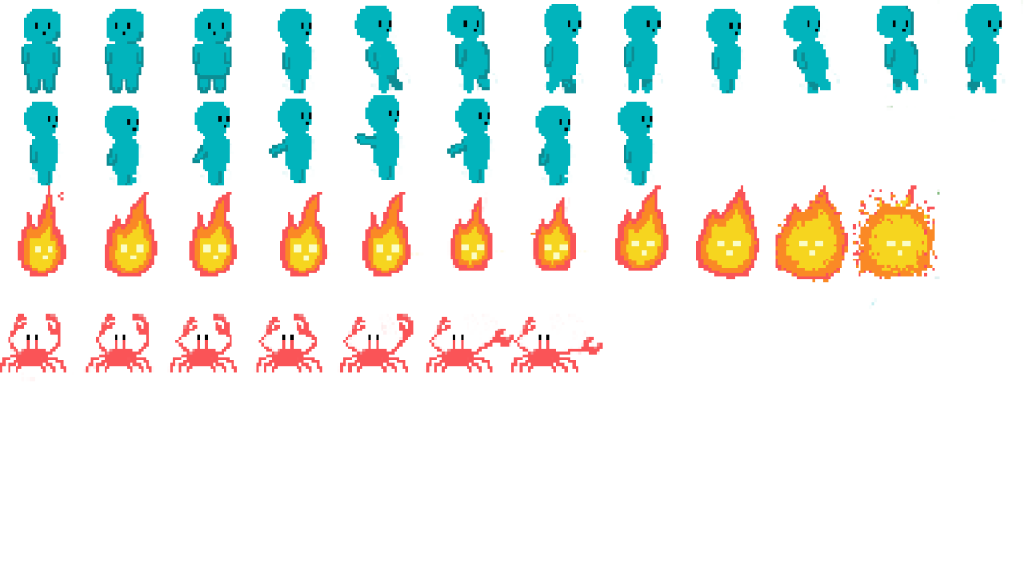
Since the prompt was to create a Mr men inspired character, I decided to use shape theory and make a cute, rounded character as many of the Mr men are also rounded. I chose a limited colour palette that was bright to fit the brief on being suitable for children and then used the colours for inspiration to create the enemies.
As my character has short legs, I made him sway backwards and forwards in his walk animation, so he waddles more than walks. I think this walk adds to the appeal of the character as its cute and fits with the message from the shape theory.
When he jumps there is a secondary action of him swinging his arms. I also built anticipation for the jump by having him bend his legs and crouch slightly before the jump, his legs also bend at the end of the jump as a follow through to show inertia and make the animation more realistic.
The fire enemy’s idle animation is flickering and growing a small amount like a flame would. The fire enemy also has a secondary action as they squint their eyes before exploding in their attack animation.
I used straight-ahead action to create the frames for this animation as each frame is only 32 by 32 the risk of changing the shape is reduced as it’s easy to see how many pixels high the character is.
Outcome